
The Cultural and Historical Relationship Between the Aramean Civilization and Syria and Lebanon
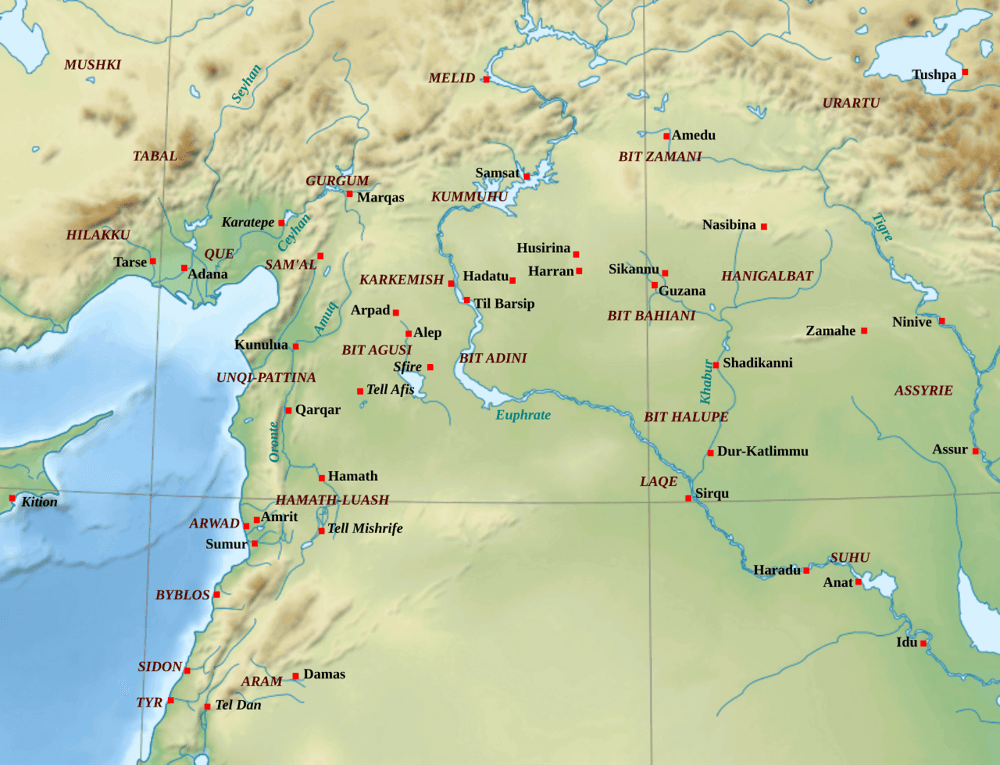
Throughout their ancient history, Syria and Lebanon experienced deep interaction with the Aramean civilization, as the geographical region occupied by these two modern states formed the vibrant heartland of the Arameans during the first millennium BCE. Aramean kingdoms flourished across the Levant, particularly in what is now Syria, while the inhabitants of the Lebanese mountains and plains benefited from sustained interaction with this civilization. Historically, the Arameans’ primary homeland lay in central Syria, but their influence extended westward toward the Phoenician coast, northward toward Anatolia, and southward toward present-day Jordan.
During this period, cities such as Damascus and Hamath emerged as prosperous Aramean centers. Damascus, located in the heart of modern Syria, served as the capital of the Kingdom of Aram-Damascus, which played a prominent role in the region’s history. The Arameans also ruled parts of what is now southern Turkey and northern Lebanon during their expansion. Some scholars associate the Kingdom of Aram-Zobah with northern and eastern Lebanese regions during the Iron Age, possibly including parts of the Beqaa Valley. It can therefore be said that Lebanon was not isolated from Aramean influence; with the exception of the coastal Phoenician cities that preserved their distinct Canaanite identity, inland Lebanese regions were influenced by Aramean culture and language, which prevailed throughout the Levant at the time. Historians have emphasized that Syria’s historical identity was largely shaped by the gradual dominance of the Aramean element in the region from around 1200 BCE onward.
On the linguistic and cultural levels, the Aramean civilization left a profound legacy in both Syria and Lebanon. The Aramaic language—especially in its Syriac form—became the principal language of Greater Syria for extended periods and continued as a language of literature and worship even after the spread of Arabic. In fact, the name “Syria” itself is derived from the term “Aram-Syria,” used by the Greeks to describe Arameans who had embraced Christianity. Greek and Roman authors applied the name “Syrians” to the Aramean peoples of the region after the Hellenistic period, and the local population gradually adopted this designation. Thus, the term “Syrians” implicitly came to refer to the Arameans as the indigenous inhabitants of Syria, reflecting the deep integration of Aramean identity into Syria’s historical identity.
In Lebanon, Aramaic was widely spoken among the general population during the Roman and post-Roman periods, alongside Greek in urban centers. With the spread of Christianity, many Arameans in Lebanon converted, and the Syriac language (Eastern Aramaic) became the language of liturgy and worship among local Christian communities. This influence persists to the present day through Eastern churches in Lebanon, such as the Maronite Church, whose liturgy is still celebrated in Syriac Aramaic, preserving a living link to the ancient Aramean language and heritage.
Moreover, many village and town names in Syria and Lebanon have Aramaic or Syriac origins, demonstrating historical continuity. For example, the name “Lebanon” itself is believed to derive from a Semitic root meaning “white” (laban in Aramaic), referring to its snow-capped mountains. Likewise, cities such as Homs (ancient Emesa) and Maarrat al-Nu‘man bear names or linguistic roots linked to Aramaic.
Beyond language, tangible cultural connections link the Aramean civilization with both Syria and Lebanon, particularly in popular heritage and social practices. Many customs and traditions in the Levantine countryside can be traced back to ancient periods predating Arab presence, some possibly originating with the Arameans. Notably, certain Syrian villages—such as Maaloula and Bakh‘a in the Qalamoun Mountains—still speak Aramaic today and chant religious hymns in their ancient mother tongue during celebrations, offering a direct window into Syria’s Aramean past. In Lebanon, traces of Aramean heritage appear in Syriac church music and in the Syriac script preserved by monks in manuscripts across centuries.
National museums in Beirut and Damascus also house rich collections of Aramean artifacts—stone inscriptions, statues, and manuscripts—that highlight the shared civilizational depth of the two countries. Archaeological discoveries, such as inscriptions found at al-Faq‘ah in the Beqaa Valley or at Tell Afis near Aleppo, provide material evidence of sustained Aramean settlement across both regions.
The historical relationship between the Arameans and Syria and Lebanon is ultimately reflected in the continuity of a Levantine cultural identity that blends Aramean and Arab heritage. Although Arabs arriving from the Arabian Peninsula in the seventh century CE brought their language and culture, they adopted many elements of the Levant’s earlier civilizations. As a result, Aramean traditions merged with Arab culture to shape modern Syrian and Lebanese identity. This was not a simple process of replacement, but rather a gradual civilizational continuity: everyday language shifted from Aramaic to Arabic, yet many vocabulary items, grammatical features, and popular proverbs retained Aramaic traces. Religious traditions evolved with the spread of Christianity and later Islam, yet Eastern Christian saints in Syria and Lebanon wrote their works in Syriac (Aramaic), transmitting the wisdom of their ancestors to new eras. Even in art and architecture, continuity is evident, as local village architecture retained building patterns, materials, and techniques rooted in Aramean times.
In conclusion, the heritage of the Aramean civilization in Syria and Lebanon constitutes a cornerstone of both nations’ cultural identities. Aramaic deeply influenced the language, popular culture, and religious life of the Levant, and its presence has endured in multiple forms across millennia. Today, Syrians and Lebanese alike take pride in their diverse civilizational legacy, which blends the ancient roots of the Arameans with the creativity of subsequent peoples—an enduring shared heritage that makes the culture of the Levant uniquely rich throughout history.